ATDERA Selective Clinical Education

27–28 March 2027 · up to six participants · 3–6 per fresh-frozen head · inject & study

Advanced Facial Anatomy & Injectables Masterclass on Fresh Frozen Cadavers

Fresh-frozen dissection · Full-face botulinum toxin · HA fillers · CaHA/PLLA biostimulators

A two-day, English-language masterclass for up to six physicians in Ankara, 27–28 March 2027, with between three and six participants sharing one fresh-frozen cadaver head: instructor-led dissection of the facial layers and danger zones, then hands-on injection of botulinum toxin, dyed hyaluronic acid fillers and biostimulators, with the injected regions dissected at the end to show the plane each product reached. Directed by anatomist Prof. Dr. Selçuk Tunalı.

Application first. Payment is requested only after written acceptance.

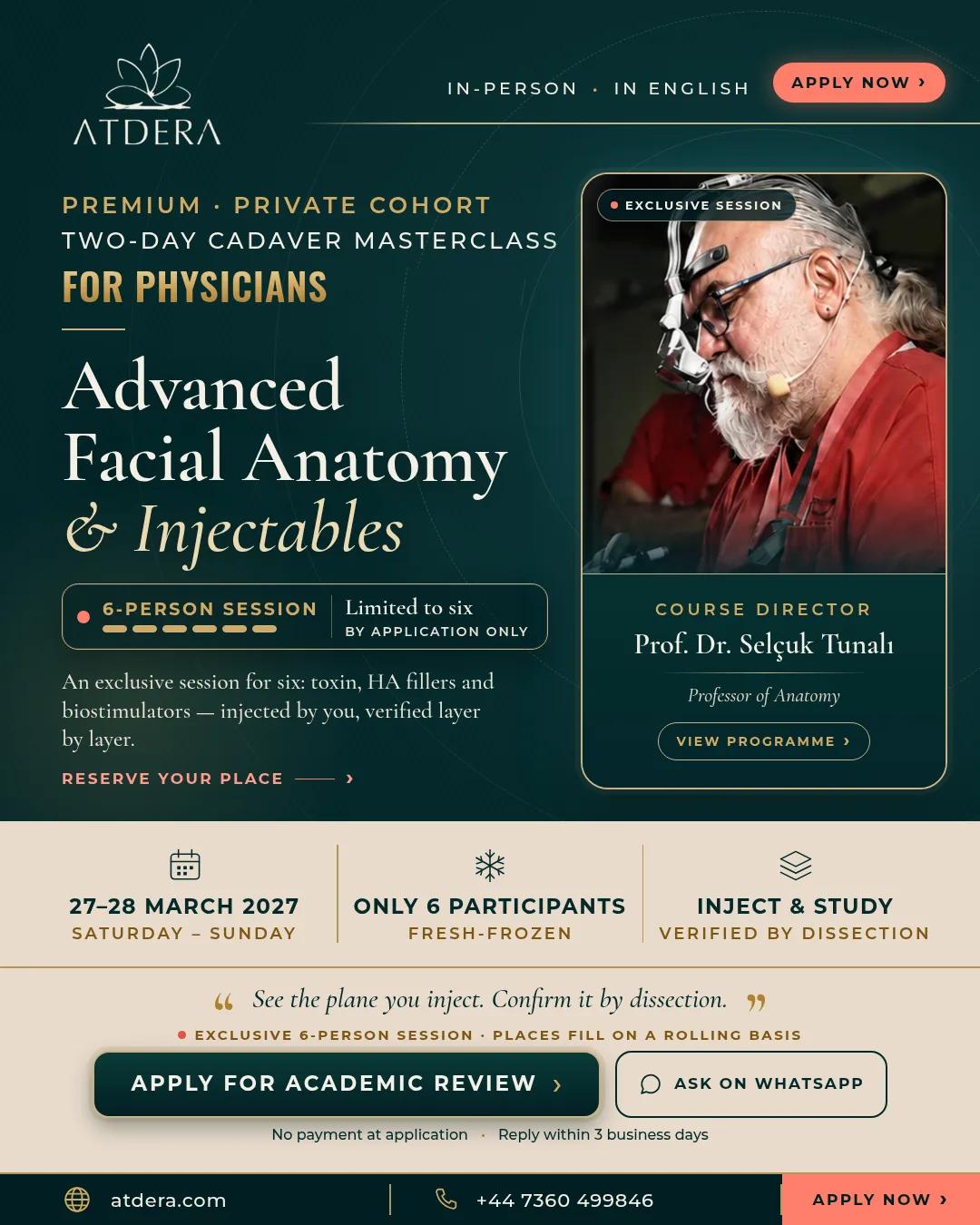
Programme poster: Advanced Facial Anatomy & Injectables Masterclass on Fresh Frozen Cadavers, 27–28 March 2027, directed by Prof. Dr. Selçuk Tunalı
Dates
Venue
TORLAK & TunaliS Anatomy Institute Joint Lab, Ankara
Language
English
Cohort
Up to 6 participants · 3–6 per cadaver head

At a glance

The programme, answered in one view

The Advanced Facial Anatomy & Injectables Masterclass on Fresh Frozen Cadavers is a two-day, English-language programme on 27–28 March 2027 at the TORLAK & TunaliS Anatomy Institute Joint Lab in Ankara, in which up to six physicians study the facial layers, danger zones and injection planes, between three and six participants sharing one fresh-frozen cadaver head: the anatomist dissects, each participant injects botulinum toxin, dyed hyaluronic acid fillers and CaHA/PLLA biostimulators by hand, and the injected regions are dissected at the end to confirm the plane. Course Director: Prof. Dr. Selçuk Tunalı, Professor of Anatomy.

Apply for academic review
Dates
Venue
TORLAK & TunaliS Anatomy Institute Joint Lab · Ankara, Türkiye
Teaching language
English
Format
Instructor demonstration + hands-on inject & study · 3–6 participants per fresh-frozen head
Fee
£2,100 per participant
Certificate
ATDERA certificate of attendance, on attendance across both days
Prerequisite
A medical licence · foundation-level injectables experience recommended

Why Cadaveric Training

See the plane you inject, then confirm it by dissection

Injectable complications begin where anatomy is assumed rather than seen. This masterclass replaces assumption with direct observation: the anatomist opens the layers in front of you, you inject on the same specimen, and the regions are dissected afterwards so the plane each product reached is visible, not inferred.

  • Fresh-frozen fidelity

    Unembalmed, fresh-frozen tissue keeps the natural colour, mobility and plane behaviour of living tissue — the closest available model to clinical reality.

  • Inject & study verification

    Dyed filler and biostimulator products are injected by each participant, and the regions are then dissected to show whether the product sits in the intended anatomical plane.

  • Nothing left unseen

    Dissection sessions are not concluded until every participant has seen every anatomical structure; questions steer minor adjustments to the dissection plan.

Fee

The fee, and what it includes

The fee is £2,100 per participant, collected in GBP. Payment is requested only after academic review and written acceptance. Lunch and coffee breaks are included on both days.

01 · The masterclass27–28 March 2027

Two-day masterclass

£2,100 per participant

Up to 6 participants · 3–6 per fresh-frozen cadaver head · instructor demonstration and hands-on inject & study · ATDERA certificate of attendance

Apply for this masterclassNo payment at application · review within three business days
Included

  • Two days of laboratory teaching — instructor demonstration and hands-on blocks
  • Dyed injectable training products and laboratory consumables, including personal protective equipment
  • Lunch and coffee breaks on both days
  • Programme coordination and admissions support

Available separately

  • Accommodation by request
  • Local transfer arrangements by request

The certificate requires attendance across both days and participation in every hands-on block.

Participants who attend both days and take part in every hands-on block receive an ATDERA certificate of attendance. It does not carry CPD or CME credit.

Cancellation and refund conditions follow the ATDERA Terms of Use.

Programme

Two intensive days from anatomy to verified injection

The timetable below is the course director's programme. The preliminary dissection is carried out by the anatomy professor on the day before the course; minor operational changes may be made without changing the educational scope.

TORLAK & TunaliS Anatomy Institute Joint Lab · Ankara

  1. Saturday, 27 March 2027 · 09:00–17:30

    Facial anatomy, danger zones and full-face toxin

    • Theoretical session — foundation and anatomy

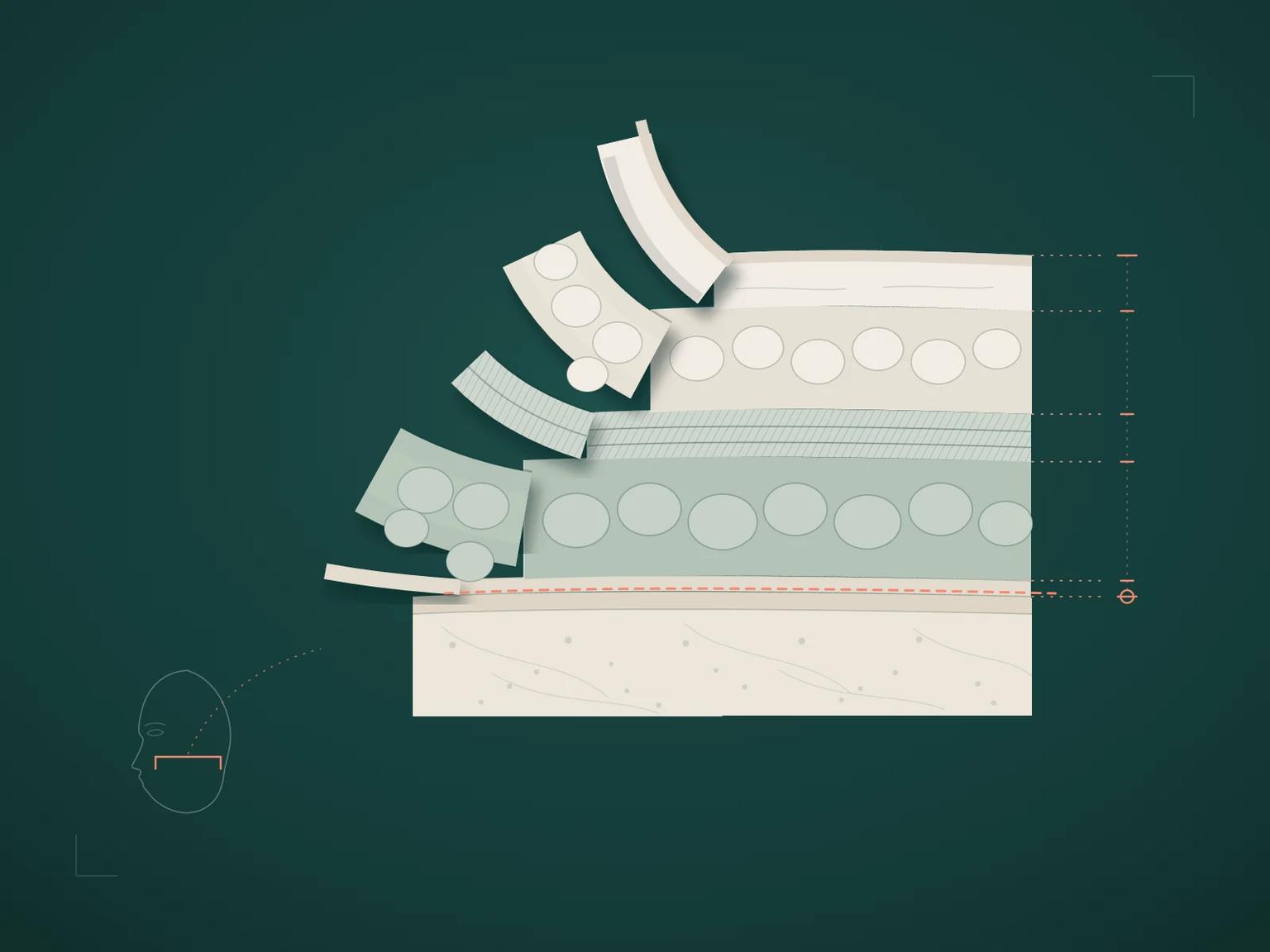
      • 3D anatomical layers of the face: skin, superficial fat pads, SMAS, deep fat pads and bone structure
      • Dynamics of the facial muscles — agonist and antagonist balances
      • Danger zones, vascular mapping and neural networks
    • Dissection I — led by the anatomy instructor

      • Questions are answered live; minor changes are made to the dissection plan accordingly
      • Not concluded until all participants have seen all anatomical structures
    • Lunch break

    • Dissection II — led by the anatomy instructor

      • Same format as Dissection I
    • Masterclass — botulinum toxin demonstration by the instructor

      • Botulinum toxin pharmacology, reconstitution techniques and correct dosing strategies
      • Live demonstration of muscle depths, injection techniques and ideal injection points on the cadaver by the instructor physician
    • Coffee break

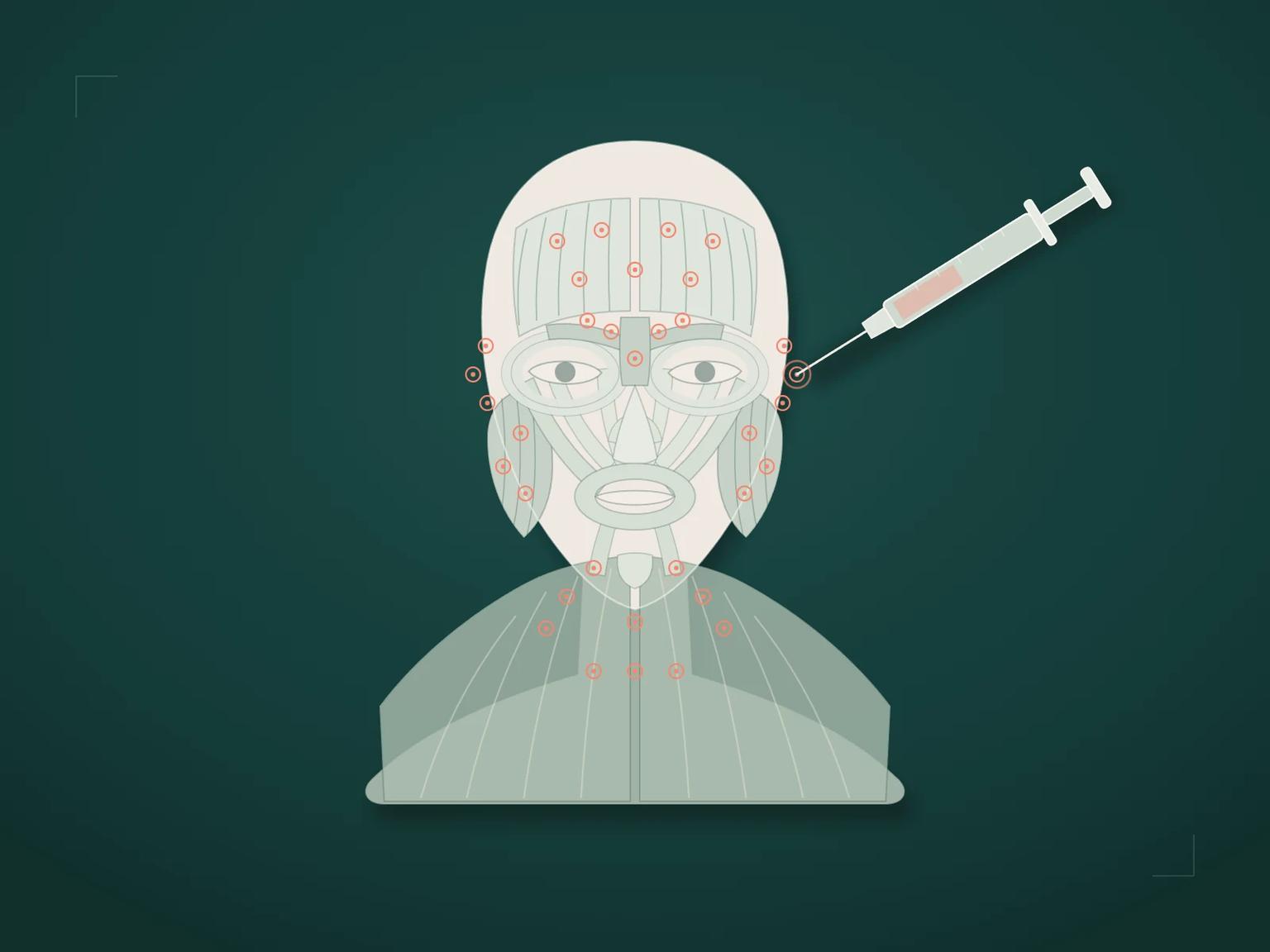
    • Hands-on — full-face and neck toxin practice, every participant on all ten regions

      • Upper face: glabellar complex (procerus and corrugator supercilii), frontalis (forehead lines and brow lifting), periorbital area (orbicularis oculi)
      • Mid face: bunny lines (nasalis), gummy smile (levator labii superioris alaeque nasi)
      • Lower face and neck: perioral lines (orbicularis oris), marionette lines (depressor anguli oris), mentalis, masseter hypertrophy (bruxism, jawline slimming), platysmal bands
  2. Sunday, 28 March 2027 · 09:00–18:00

    3D facial restoration — fillers and biostimulators

    • Masterclass — hyaluronic acid filler demonstration

      • Filler rheology (G′, cohesivity) and product selection
      • Cannula versus needle use and injection techniques into different anatomical layers
      • Inject-and-dissect demonstration by the instructor
    • Hands-on — dyed HA filler injection into safe layers, nine regions

      • Upper and mid face: temporal hollowing (superficial and deep fascial planes), tear trough and infraorbital hollows (ligament anatomy), zygomatic arch and anteromedial cheek, nasal dorsum and radix (non-surgical rhinoplasty planes and nasal artery dangers)
      • Lower face: nasolabial folds (pyriform fossa deep injection), melomental folds, lips (vermilion border, Cupid's bow and tubercles), jawline contouring (mandibular angle), chin projection
    • Lunch break

    • Masterclass — biostimulator demonstration (CaHA and PLLA)

      • Mechanisms of action of calcium hydroxylapatite and poly-L-lactic acid
      • Avoiding incorrect planes to prevent nodule and granuloma formation; dilution and hyperdilution principles
    • Coffee break

    • Hands-on — biostimulator injection in structural areas, then dissection of the injected regions

      • Malar and submalar region, pre-auricular area, jawline and lower-face laxity (vectorial lifting), neck and décolletage (hyperdilute CaHA), dorsum of the hand
      • Regions where biostimulators must never be applied — under-eyes and lips — are excluded
      • Exploration of the participants' filler injections by dissection
    • Closing, questions and certificate ceremony

Masterclass Architecture

Two days. Four modules. One verified anatomical standard.

The programme moves from three-dimensional anatomy and danger zones to full-face botulinum toxin, then to hyaluronic acid fillers and CaHA/PLLA biostimulators — up to six physicians, between three and six sharing one fresh-frozen cadaver head.

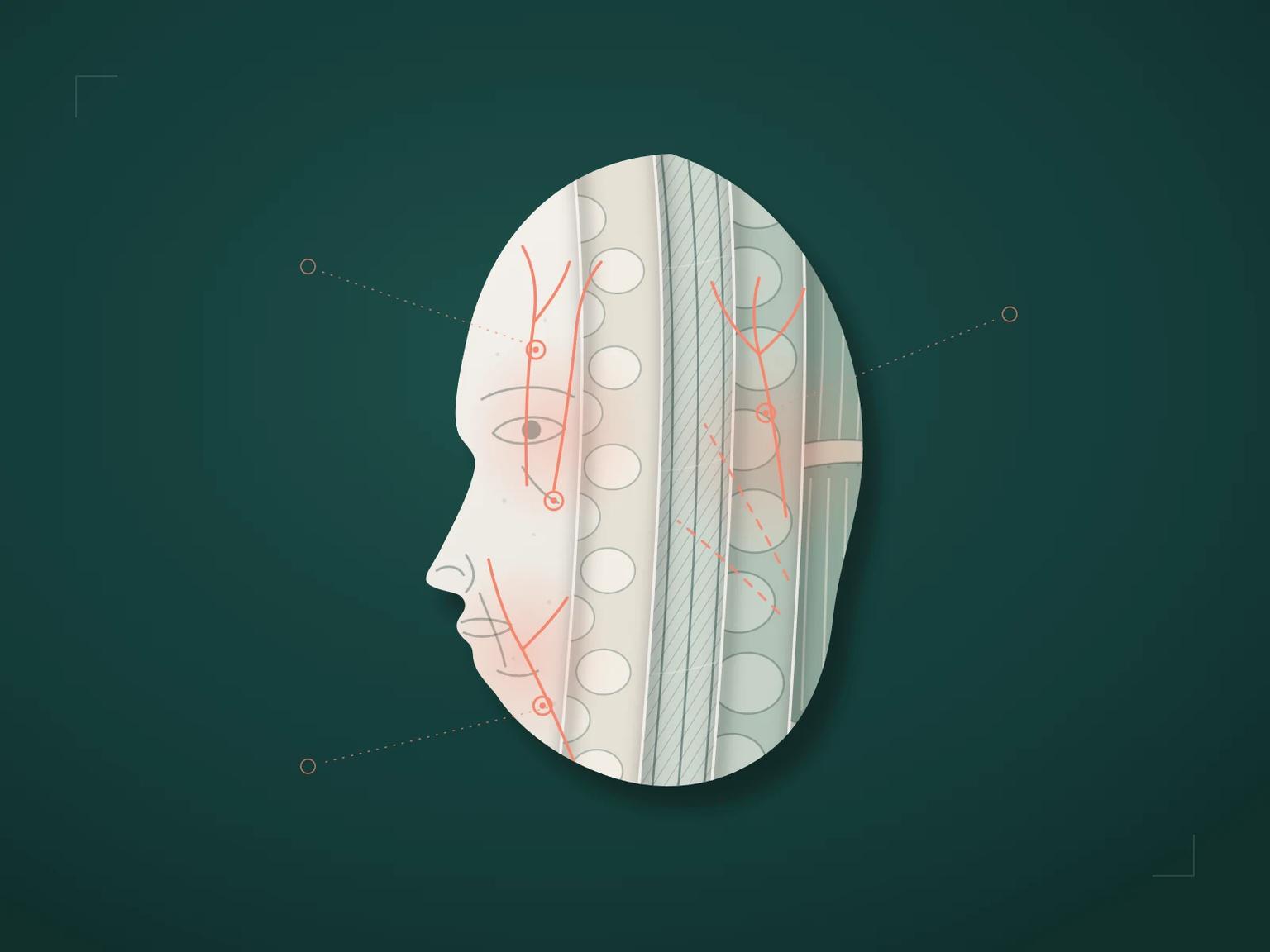
Illustration of layered facial anatomy with vascular and neural danger zones marked
ANATOMY

3D Facial Anatomy & Danger Zones

Skin, superficial fat pads, SMAS, deep fat pads and bone; agonist–antagonist muscle dynamics; danger zones, vascular mapping and neural networks.

Day 1 · theoretical foundation
Cross-section illustration of facial tissue layers lifted to reveal the injection planes
DISSECT

Instructor-Led Cadaver Dissection

Two guided dissection sessions in which questions are answered live and the plan adjusts to the group — never concluded until all structures have been seen by everyone.

Day 1 · two sessions
Facial muscle-map illustration with botulinum toxin injection points across the face and neck
BTX

Full-Face & Neck Botulinum Toxin

Pharmacology, reconstitution and dosing strategy, then hands-on practice of ten regions from the glabellar complex to the platysmal bands.

Day 1 · hands-on on the cadaver
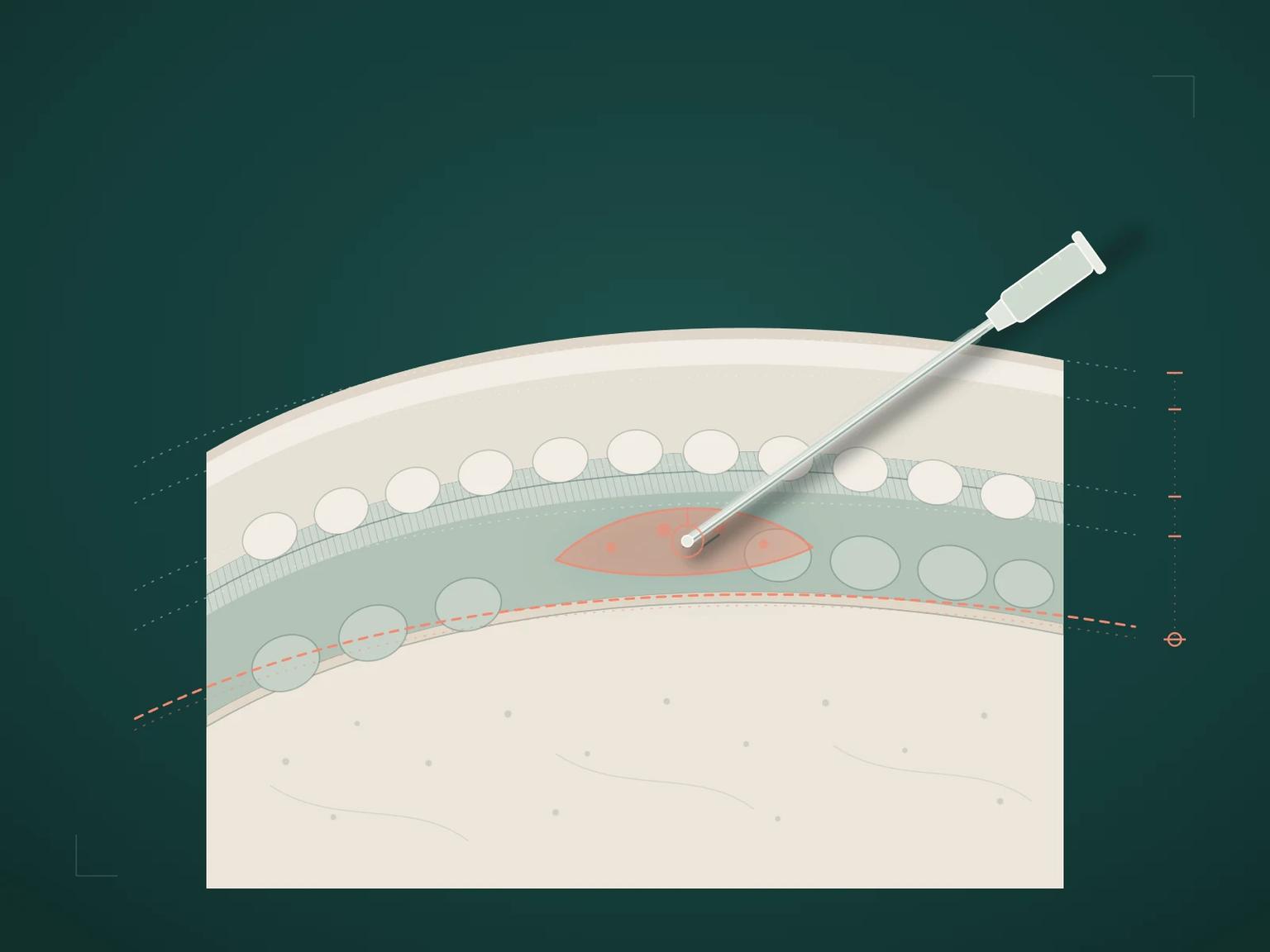
Cross-section illustration of a cannula depositing dyed filler in the correct tissue plane
HA·BIO

Fillers & Biostimulators — Inject & Study

Dyed hyaluronic acid fillers across nine facial regions, then CaHA and PLLA biostimulators in structural areas — the injected regions dissected afterwards to verify the plane.

Day 2 · dyed-product verification

Faculty

Directed by Prof. Dr. Selçuk Tunalı, Professor of Anatomy

The dissection sessions are led by the course director. The toxin, filler and biostimulator demonstrations are led by physician instructors in medical aesthetics, named on this page before enrolment.

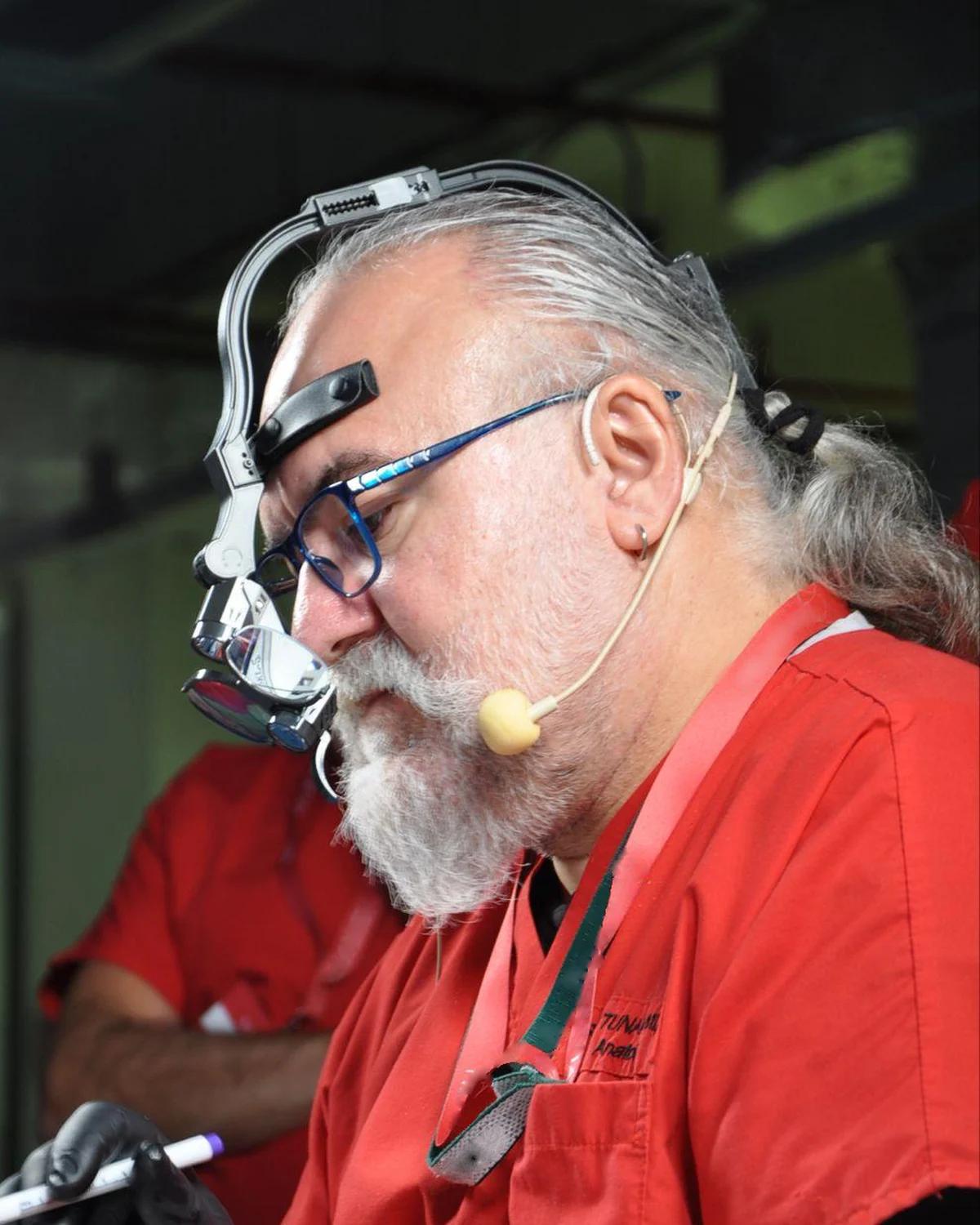
Prof. Dr. Selçuk Tunalı

Course Director · Anatomy

Prof. Dr. Selçuk Tunalı

  • Professor of Anatomy: TOBB University of Economics and Technology Faculty of Medicine, the University of Hawaii School of Medicine, and Hacettepe University.
  • Founding faculty member, Vice Dean and Dean of the TOBB ETU Faculty of Medicine.
  • Head and faculty member of 179 fresh-frozen cadaveric dissection courses in surgical and clinical anatomy.
  • Numerous international publications; founder and former Editor-in-Chief, International Journal of Anatomical Variations.
  • Host of the 21st International Conference on Plastination, Istanbul.
View the full curriculum vitae at tunalis.org

Clinical Faculty

Physician instructors in medical aesthetics — to be announced

The instructors who lead the injection demonstrations and supervise the hands-on blocks are named here before enrolment. ATDERA names faculty only with their written permission.

Train at the specimen with this faculty

Apply for academic review

Who Should Apply

For licensed physicians who want anatomical certainty in injectable practice

The masterclass is designed for licensed physicians; international registrations are welcome. Applications are academically reviewed to keep the group at no more than six and the hands-on time at the dissection table balanced.

Suitable backgrounds

  • Physicians in dermatology, plastic surgery or aesthetic medicine who want to deepen their anatomical precision
  • Physicians who want to recognise and avoid the danger zones behind vascular and nerve complications
  • Experienced injectors who want to see their planes and techniques verified on cadaveric tissue
  • International physicians — the masterclass is taught entirely in English

Before the masterclass begins

  • A valid medical licence; international registrations are welcome
  • Foundation-level injectables experience is recommended: the masterclass assumes familiarity with basic techniques
  • Identity document and professional CV for academic review
  • A participant agreement covering laboratory conduct, confidentiality and photography

The certificate records attendance across both days; it does not carry CPD or CME credit.

Fit check

Is this masterclass for you? Three questions

A short self-check before you apply. It suggests whether the programme matches your practice; the academic review still makes the decision.

Your professional registration
Your injectables experience
What do you want from the two days?

Answer the three questions to see our suggestion.

The Laboratory

Ankara, Türkiye

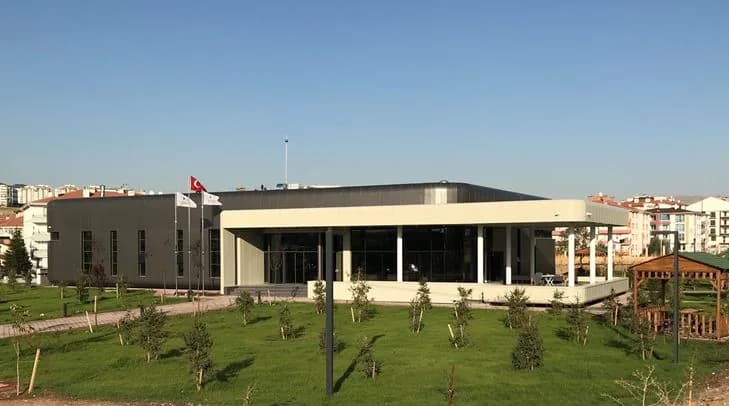
TORLAK & TunaliS Anatomy Institute Joint Lab

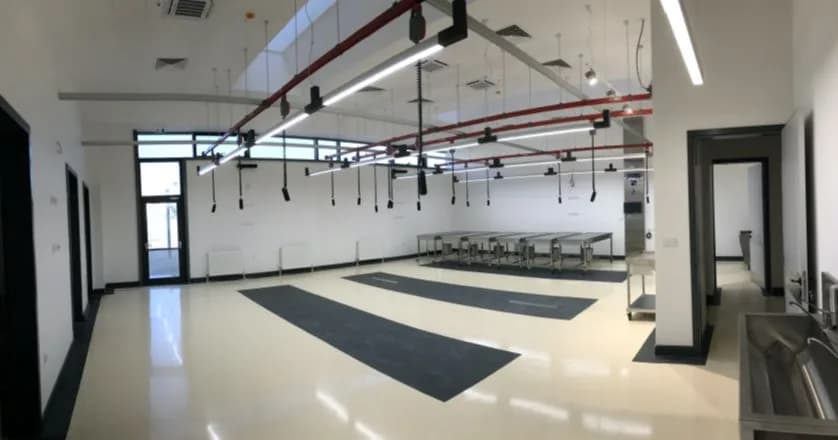
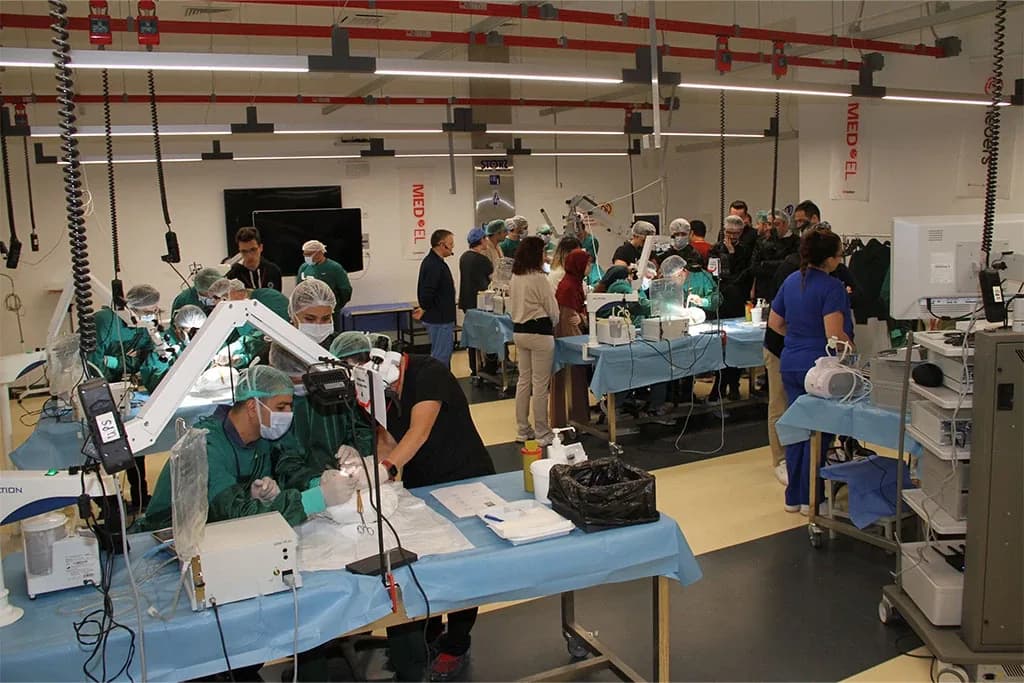
The masterclass runs in the TORLAK & TunaliS Anatomy Institute Joint Lab in Ankara, with full personal protective equipment and clinical-waste and sharps management throughout. Arrival details and laboratory conduct are sent to accepted participants with the laboratory briefing.

Accommodation and local transfer arrangements can be requested separately through the programme office after acceptance.

Entrance front of the TORLAK & TunaliS Anatomy Institute Joint Lab building in AnkaraThe dissection laboratory: stainless-steel tables beneath ceiling-mounted equipment railsA dissection course under way in the laboratory, with a microscope at each stationThe laboratory building and its landscaped grounds seen from above
TORLAK & TunaliS Anatomy Institute Joint Lab, Ankara

What happens after you apply

Five steps, and no payment until you are accepted

  1. Apply

    Submit the short form. No payment is taken.

  2. Academic review

    A response within three business days; a CV may be requested.

  3. Confirm your place

    After written acceptance, pay in GBP within three business days.

  4. Receive the laboratory briefing

    Dates, venue, conduct and personal protective equipment guidance, sent to accepted participants.

  5. Attend the masterclass

    27–28 March 2027 · TORLAK & TunaliS Anatomy Institute Joint Lab, Ankara.

Application

Academic review comes before payment

Applications reviewed on a rolling basis · six places · 27–28 March 2027

Submit a concise professional application. The programme office aims to respond within three business days and sends accepted applicants the venue details and payment instructions.
  • No payment at application
  • A response within three business days
  • ATDERA issues the certificate of attendance
  1. Submit the application form — no payment is taken at this stage.
  2. The academic team reviews your application within three business days and may request a CV by email or direct contact.

  3. If accepted, you receive the venue details and payment instructions in writing; your place is confirmed on payment of £2,100 in GBP.
+1

Your information is used only for admissions review and programme communication. No payment is taken through this form.

Essential Information

Frequently asked questions

Still deciding? The programme office answers on WhatsApp and by email.

Ask on WhatsApp
What is a fresh-frozen cadaver, and why not embalmed tissue?

Fresh-frozen cadaveric tissue is preserved by freezing rather than chemical embalming, so it keeps the natural colour, mobility and plane behaviour of living tissue. That fidelity is what lets dissection findings and injection planes transfer directly to clinical practice.

Who can attend the masterclass?

Licensed physicians; international registrations are welcome. Every application goes through academic review, and foundation-level injectables experience is recommended.

How is the hands-on time organised?

Between three and six participants share one fresh-frozen cadaver head, with an instructor demonstration before every hands-on block and the anatomist leading each dissection; the group never exceeds six, and every participant injects by hand.

Do participants dissect themselves?

No. The preliminary dissection is carried out by the anatomy professor the day before, the dissection sessions during the course are led by the instructor, and participants carry out the injections. At the end of day two the injected regions are dissected to show the plane each product reached.

What does 'inject and study' mean?

Each participant injects dyed filler and biostimulator products into defined regions; those regions are then dissected so the group can see — not assume — whether the product sits in the intended anatomical plane.

Which regions and products does the curriculum cover?

Day one covers three-dimensional facial anatomy, danger zones and full-face and neck botulinum toxin across ten regions. Day two covers hyaluronic acid fillers across nine facial regions and CaHA/PLLA biostimulators in structural areas — all taught with generic, product-independent science.

What certificate will I receive?

Participants who attend both days and take part in every hands-on block receive an ATDERA certificate of attendance. It records attendance and does not carry CPD or CME credit.

When and where will the masterclass take place?

The masterclass runs on Saturday 27 and Sunday 28 March 2027 at the TORLAK & TunaliS Anatomy Institute Joint Lab in Ankara. Applications are reviewed on a rolling basis until the six places are filled.

When do I pay, and what does the fee include?

The fee is £2,100 per participant, collected in GBP and requested only after academic review and written acceptance. It includes both days of laboratory teaching, dyed training products and consumables, personal protective equipment, lunch and coffee breaks. Accommodation and transfers are not included but can be arranged on request.

Apply for the March 2027 cohort

27–28 March 2027 · TORLAK & TunaliS Anatomy Institute Joint Lab, Ankara · £2,100 per participant

Application first. Payment is requested only after written acceptance.