

The clinical question this article answers
Patients searching online for dental implant treatment encounter three procedure names — single-tooth implant, implant-supported bridge, and All-on-4 or All-on-6 — and a marketplace that often presents them as competing products rather than as clinically distinct interventions. The decision between them is not a preference question. It is a clinical question driven by how many teeth are missing, where in the arch they sit, the residual bone volume at each potential implant site, the condition of any remaining natural teeth, and the patient's prosthetic plan over the next ten to twenty years.
This article reads each of the three pathways in turn and sets out the clinical scenarios for which each is the appropriate choice. It is not a comparison matrix. The aim is to help a UK reader who has been told by one practice that they need a single-tooth implant, by a second that an implant bridge would suffice, and by a third that they would be better served by full-arch rehabilitation, to understand why the three opinions are not necessarily contradictory — and to understand which clinical evidence resolves the difference.
The article does not quote prices. The cost composition of each pathway is described in clinical terms — the line items that any customised written estimate from a UK private practice or an ATDERA-coordinated pathway in Turkey will surface — but specific figures vary by case and by year. A case-specific written estimate is issued by ATDERA after a remote case review of the CBCT scan and history, and the same is true for any UK private practice that quotes implant treatment responsibly.
Single-tooth implant — when one missing tooth is the right scope
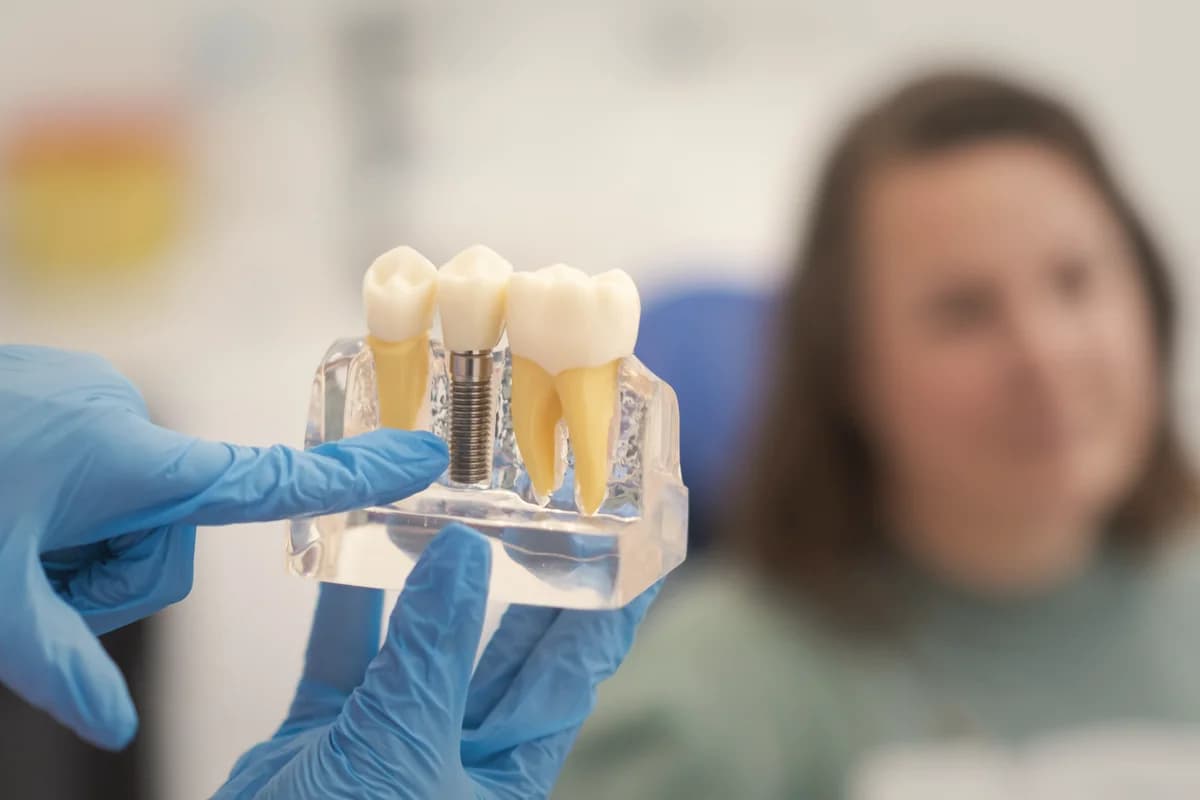
A single-tooth implant is a medical-grade titanium root placed in the jawbone at the site of one missing tooth, restored after osseointegration with a custom ceramic or zirconia crown that is supported entirely by the implant. The adjacent natural teeth are not involved in the restoration. Where the neighbouring teeth are sound, this is the more biologically conservative option than a conventional three-unit bridge, which would require preparing the two adjacent teeth and committing them to support a pontic for a third.
The clinical indication for a single-tooth implant is straightforward: one missing tooth, healthy adjacent teeth, adequate bone volume at the implant site, and no plan to extract neighbouring units in the foreseeable future. The CBCT scan measures bone height and width at the specific site and maps proximity to the maxillary sinus or the inferior alveolar nerve. Where bone volume is reduced, ridge augmentation or a sinus lift may be performed alongside or before placement, which extends the timeline but does not change the underlying recommendation.
Single-tooth implant treatment is the wrong scope where multiple adjacent teeth are missing, where the patient has long-span bridge work that is failing, or where the prosthetic plan over the next decade involves extracting further units in the same arch. In those scenarios, planning a sequence of single-tooth implants one at a time can produce a less stable final occlusion than treating the arch as a coordinated case from the outset, and it can result in higher cumulative cost than a multi-unit bridge or a full-arch rehabilitation.
Long-term clinical studies report single-tooth implant survival above 97% at ten years and above 90% at twenty years, where the implant is placed by a trained implantologist and supported by regular professional maintenance. The crown fitted to the implant typically lasts 10–15 years before replacement is considered, depending on prosthetic material and individual occlusion. The implant itself, once osseointegrated, behaves as a stable structural unit and is reviewed separately from the crown for replacement and follow-up purposes.
An additional clinical question that arises with single-tooth cases is whether to place the implant immediately at the time of extraction or to delay placement by eight to twelve weeks. Both protocols are clinically valid; the choice rests on the condition of the extraction socket, the integrity of the buccal bone wall, the presence or absence of active infection, and whether adequate primary stability of the implant can be achieved at the time of placement. The verified partner clinician on the ATDERA pathway documents the rationale for either protocol in the written case plan, so the patient reads the clinical reason rather than a default protocol.
Multi-tooth implant bridges — when two or three adjacent teeth need replacing
An implant-supported bridge replaces two or more adjacent missing teeth using fewer implants than there are teeth — most commonly, a three-unit bridge supported by two implants, or a four-unit bridge supported by two or three implants. The pontic units between the implants are suspended structurally by the abutment crowns on the implants themselves rather than by adjacent natural teeth. This is structurally and biologically distinct from a conventional bridge, which uses two natural teeth as abutments and removes healthy enamel and dentine to do so.
The clinical indication is two or more adjacent missing teeth in the same quadrant of the arch, where the residual bone volume is sufficient to support implants at the planned abutment positions. The CBCT scan plans the implant trajectories and the abutment configuration, and the prosthodontic plan determines the bridge material — most often zirconia for posterior load-bearing units, lithium disilicate where translucency in the smile zone is the dominant variable. Where bone volume is reduced at one or more abutment sites, ridge augmentation is staged in alongside placement.
An implant-supported bridge is preferred over a series of individual single-tooth implants when the cost composition, the restorative timeline, or the occlusal plan favours a single coordinated restoration. Two implants supporting three units typically costs less than three single implants supporting three crowns, the prosthetic stages are shorter because one impression and one fitting visit cover three teeth, and the final occlusion is engineered as a single unit rather than three independent restorations that are reviewed in isolation.
Implant-supported bridges are the wrong scope where the missing teeth span an entire arch or where remaining natural teeth in the same arch are themselves prognostically uncertain. Building a multi-unit bridge against natural teeth that may need extraction within the next five years compromises the bridge plan and can force a more disruptive revision later. In those cases, the clinical conversation moves to full-arch rehabilitation as the more durable starting point.
Long-term outcomes for implant-supported bridges are reported in the same survival range as single-tooth implants, with the prosthesis itself typically reviewed for replacement at 10–15 years depending on the prosthetic material and the patient's occlusal profile. The bridge is reviewed as a structural unit at each annual maintenance visit, alongside the implants supporting it. Where one implant in a multi-unit bridge presents an issue at long-term review, the bridge framework allows the affected unit to be addressed without disturbing the rest of the prosthesis — a structural advantage over fully tooth-supported bridge work where loss of one abutment compromises the entire restoration.
All-on-4 — when an entire arch needs a fixed restoration
All-on-4 is a full-arch implant rehabilitation technique in which four titanium implants anchor a fixed ceramic or zirconia bridge that replaces an entire arch of teeth. The two posterior implants are angled by up to 45 degrees to maximise contact with available bone, which often allows treatment to proceed without a separate sinus lift or extensive bone grafting procedure. In suitable cases the immediate-loading protocol is used to attach a temporary fixed prosthesis on the same day, so the patient leaves the surgical visit with a functional dentition.
The clinical indication is complete or near-complete tooth loss in one or both jaws, or a failing dentition in which long-span bridge work and repeatedly fractured restorations have reached the end of their restorative life. All-on-4 is also indicated for patients with diminished posterior bone volume who have been told elsewhere that they would require extensive grafting before any implant treatment, and who are seeking a second-opinion review of whether angled posterior implants make full-arch rehabilitation feasible without that adjunctive surgical stage.
The technique has a documented clinical history. Long-term studies report implant survival above 97% at ten years where the implant is placed by a trained implantologist and supported by regular professional maintenance, and the immediate-loading full-arch protocol has been employed in the successful treatment of several hundred thousand patients globally. The full-arch bridge fitted to the implants typically lasts 10–15 years before replacement is considered, depending on the prosthetic material — an acrylic-titanium hybrid is generally replaced earlier than a monolithic zirconia prosthesis.
All-on-4 is the wrong scope where the patient has a single missing tooth between healthy adjacent teeth, where the missing teeth are confined to one quadrant, or where remaining natural teeth in the arch are sound and structurally restorable. Treating an arch with All-on-4 means committing to extraction of any remaining natural teeth at the surgical visit; that is appropriate where those teeth are non-restorable, but it is not a reasonable starting point for an arch that retains five or six structurally sound units.
The temporary fixed prosthesis attached on the surgical day under the immediate-loading protocol is a working functional dentition, not a final restoration. The patient eats a soft diet for six to eight weeks and avoids hard or chewy foods on the temporary while the implants integrate. The final ceramic or zirconia full-arch bridge is fitted three to six months later at the second visit, once osseointegration is confirmed by clinical and radiographic assessment. The two-stage timeline is a biological constant; treatment compression that fits the final prosthesis before integration is complete carries documented clinical risks and is not how the ATDERA pathway is structured.
All-on-6 — the more conservative full-arch alternative
All-on-6 uses six titanium implants rather than four to support a fixed full-arch prosthesis. The additional two implants are placed in the posterior segments where bone volume allows, distributing the biting load across six anchor points rather than four. This reduces the per-implant force, supports a more stable final prosthesis, and is often the more durable choice for patients with strong occlusal forces, a longer prosthetic lifespan in mind, or a clinical profile where the additional anchor points are warranted.
The clinical indication overlaps with All-on-4 — complete or near-complete arch tooth loss, failing dentitions, long-term denture intolerance — but the decision between four and six implants is driven by bone volume in the posterior arch, the patient's bite force, and the prosthetic plan over the next twenty years. Where posterior bone is sufficient and the patient's occlusion is heavy, All-on-6 is generally preferred. Where posterior bone is reduced and angled placement is the more proportionate route, All-on-4 with cantilevered posterior units is the appropriate choice.
All-on-6 is not a marketing upgrade of All-on-4. Both are evidence-based protocols supported by long-term clinical literature, and the choice between them is a clinical decision rather than a tier selection. The verified partner implantologist on the ATDERA pathway documents the rationale — bone volume at each planned site, the prosthetic plan, the occlusal profile — in the case-specific written estimate, so the patient can read why four or six implants is being recommended for their specific arch rather than reading two prices and being asked to pick.
Long-term outcomes for All-on-6 are reported in the same survival range as All-on-4 in peer-reviewed literature, with both protocols above 97% at ten years where the implant is placed by a trained implantologist. The structural advantage of six implants is realised most clearly in patients with heavy occlusal forces and in arches where posterior anchor points reduce cantilever stress on the prosthesis itself, which extends the working life of the bridge between scheduled replacements.
The cost composition of an All-on-6 estimate differs from an All-on-4 estimate primarily in the implant and abutment line items — six implants and six multi-unit abutments rather than four — and to a lesser extent in the surgical-time line item, since six placements take longer than four. The prosthesis material, the clinician fee for the prosthetic-fitting visit, and the laboratory work are broadly comparable across the two protocols. The case-specific written estimate surfaces the line items separately so the patient can read the structural cost of the additional anchor points against the structural benefit, with the verified partner clinician's rationale documented alongside.
The decision tree, simplified
The clinical decision between single-tooth implants, implant-supported bridges, and All-on-4 or All-on-6 is structurally a tree, not a comparison. The first question is how many teeth are missing in the arch, and where they sit. The second is the condition of the remaining natural teeth and their prognostic outlook over the next decade. The third is residual bone volume at each potential implant site. The fourth is the patient's prosthetic plan and occlusal profile. The fifth, only after the first four are answered, is cost composition.
One missing tooth between healthy adjacent teeth resolves to single-tooth implant placement. Two or three adjacent missing teeth in one quadrant, with sound bone at the planned abutment positions, resolves to a multi-unit implant-supported bridge. Complete or near-complete tooth loss in an arch — or a failing dentition where the remaining natural teeth are non-restorable — resolves to All-on-4 or All-on-6 full-arch rehabilitation, with the choice between four and six implants driven by posterior bone volume and occlusal profile.
The branches are not interchangeable. Treating a single missing tooth with a four-implant full-arch protocol is a clinical over-reach. Treating a near-edentulous arch with five or six staged single-tooth implants is structurally weaker and typically more expensive than a coordinated full-arch case. The verified partner implantologist on the ATDERA pathway maps each case onto the tree at the remote case review and documents the rationale in the written estimate so the patient can read why one branch is recommended rather than another.
- One missing tooth, healthy adjacent teeth → single-tooth implant
- Two or three adjacent missing teeth, one quadrant → implant-supported bridge
- Edentulous or near-edentulous arch, reduced posterior bone → All-on-4 with angled posterior implants
- Edentulous or near-edentulous arch, sufficient posterior bone, heavy occlusion → All-on-6
Cost composition across the three options
Expenditure ranges for implant treatment delivered through the ATDERA Care Network in Turkey are typically a fraction of UK private clinic equivalents for the same implant brand, prosthesis material, and clinician seniority. The cost composition is structural rather than promotional: the same components — clinician fee, implant brand and system, prosthesis material, surgical complexity, adjunctive procedures — are surfaced as separate line items in the customised written estimate, regardless of which of the three pathways is being quoted.
A single-tooth implant estimate covers one implant, one abutment, one ceramic crown, and any adjunctive procedure such as ridge augmentation or a sinus lift. A multi-unit implant-supported bridge estimate covers the implants used as abutments, the abutment fittings, the multi-unit bridge as a single laboratory unit, and any adjunctive procedure. An All-on-4 or All-on-6 estimate covers four or six implants, the multi-unit abutment configuration, the immediate-loading temporary prosthesis, and the final ceramic or zirconia full-arch bridge as a separate prosthetic stage three to six months later.
The line items remain readable across the three pathways. A patient who reads a single-tooth implant estimate and a full-arch estimate side by side can identify exactly where the cost difference sits — additional implants, a larger prosthesis, longer surgical time, two travel dates rather than one. The estimate is not a bundled headline figure. The financial picture is settled in writing before any travel plan is made, and the patient's UK or home-country dentist can read each clinical component independently if a second opinion is sought.
The British Dental Association publishes an annual Private Fee Survey that summarises UK private dental implant fees by region and by procedure type. The survey is the underlying provenance UK patients can consult for the cost composition of equivalent treatment in the UK private sector. Reading the survey alongside the case-specific written estimate from an ATDERA-coordinated pathway in Turkey makes the structural cost difference visible by component — not as a comparative headline but as a side-by-side reading of clinician fee, implant brand, prosthesis material, and adjunctive procedure across the two markets.
What ATDERA's evaluation pathway looks like in practice
The evaluation step on an ATDERA pathway begins with the pre-consultation enquiry. The intake collects the patient's clinical history, current imaging where available, and the procedure interest. Where the imaging is sufficient for planning, the verified partner implantologist reviews the case and confirms candidacy in writing, typically within one working day. Where the imaging is older than twelve months or insufficient for surgical planning, the partner facility schedules a fresh CBCT in-country before the surgical visit.
The remote case review reads the CBCT scan, the panoramic radiograph, the structured clinical and medical history, and the patient's photographic record of the missing-tooth site or sites. The review confirms the appropriate pathway — single-tooth, multi-unit bridge, All-on-4, or All-on-6 — and identifies any adjunctive procedure required before or alongside placement. The written summary documents the rationale: which units are being treated, with which configuration, against which residual bone volume, and with which prosthetic plan.
Once the case is reviewed, a customised written estimate is issued with the clinician fee, the implant brand and system, the prosthesis material, the surgical complexity, and any adjunctive procedure listed as separate line items. The patient reads the estimate in their own time, alongside their UK or home-country dentist if helpful, and decides whether to proceed. There is no commitment to travel until the pathway is confirmed in writing, and patients who decide not to travel are not pursued.
The evaluation pathway is built so the clinical conversation precedes the financial one. The patient reads the recommended pathway and the rationale before reading any line-item value. Where the patient or the patient's UK dentist queries the recommendation — for example, asking whether All-on-6 should be considered alongside the All-on-4 the partner clinician has recommended — the clinician's response is documented in writing, and any revised estimate reflects the revised clinical plan. The estimate is not the start of the conversation; it is the document that captures the clinical conversation in numeric terms.
Common patient questions ATDERA partner clinicians address
The questions UK patients ask most often at the evaluation stage cluster around the same clinical decisions covered above — how many implants are appropriate for the case, whether immediate placement is feasible after extraction, whether reduced posterior bone rules out full-arch rehabilitation, and how the three pathways compare on long-term outcomes. The verified partner implantologist on the ATDERA pathway answers these in writing during the remote review, with the rationale anchored in the CBCT scan and the documented prosthetic plan rather than in headline figures.
A second cluster of questions concerns the post-operative pathway. Patients ask how week-1 swelling is managed, when they can return to office work, what the soft-diet protocol covers during osseointegration, and what the structured remote review schedule looks like within 1st week, 6th week, and 3rd month. The ATDERA pathway documents the cadence in writing and the partner clinician on file conducts each scheduled review by video and structured clinical questionnaire, with photographs contributed by the patient.
A third cluster concerns continuity of care once the patient has returned home. Patients ask whether their UK or home-country dentist can read the pathway file, whether the implant passport is provided in writing, and whether the patient's home dentist can perform routine maintenance and unrelated dental work without conflicting with the implant pathway. The pathway file is shared on request, the implant passport is issued at the partner facility before the patient returns home, and the patient's home dentist holds the relationship of record for routine maintenance.