

Why Male Factor Deserves Structured Attention in ART Training
Professional-body guidance is consistent on one point: infertility is a condition of the couple, and the male partner's evaluation is an integral part of the work-up rather than an optional extension of it. Both the American Society for Reproductive Medicine (ASRM) and the European Society of Human Reproduction and Embryology (ESHRE) frame male-factor assessment as a standard component of the infertility consultation, and the peer-reviewed literature indexed on PubMed describes male factor as a contributor in a substantial share of couples presenting to ART units.
Yet many clinicians arrive in reproductive medicine from gynaecology-weighted training pathways in which andrology received comparatively little curricular time, while embryologists sit at the receiving end of every retrieval decision: they process the aspirate or tissue, search it, and perform the ICSI that follows. A shared, structured understanding of the male-factor pathway is therefore a legitimate training objective for both professional groups, and it is the frame this overview adopts.
Interpreting the Semen Analysis: The Entry Point of the Work-Up
The semen analysis remains the entry point of the male work-up, and clinicians are trained to read it as a screening instrument rather than a verdict. The World Health Organization's laboratory manual for the examination and processing of human semen, in its current edition, standardises how samples are collected, examined and reported, and provides distribution-based reference ranges; ASRM guidance emphasises that values outside those ranges identify men who warrant further evaluation rather than men who cannot conceive.
Several habits of interpretation are worth teaching explicitly.
- Repeat before you conclude — semen parameters vary within the same individual, and pre-analytical factors such as abstinence interval, collection conditions, transport time and recent febrile illness influence results. Guidance therefore supports evaluating more than one sample before attaching a diagnostic label.
- Use the terminology precisely — oligozoospermia (reduced concentration), asthenozoospermia (reduced motility), teratozoospermia (reduced normal morphology) and azoospermia (no spermatozoa in the ejaculate) describe findings, not diseases; combinations are common, and each term should send the clinician back to history, examination and endocrine assessment for an explanation.
- Confirm azoospermia properly — azoospermia is only reported after the laboratory has examined a centrifuged pellet of the sample; the distinction between azoospermia and severe oligozoospermia or cryptozoospermia matters, because rare ejaculated spermatozoa can change the laboratory plan entirely.
Obstructive Versus Non-Obstructive Azoospermia
For the ART clinician, the operative question a confirmed azoospermic result raises is not “can this couple be treated?” but “is this obstructive or non-obstructive?” — because everything that follows depends on that answer.
Obstructive azoospermia (OA) describes normal spermatogenesis behind a blocked or absent excurrent ductal system — after vasectomy, with congenital bilateral absence of the vas deferens (CBAVD), or following infection or surgery. Non-obstructive azoospermia (NOA) describes a primary failure of sperm production within the testis. The two conditions share a semen-analysis finding and almost nothing else, which is why joint guidance from ASRM and the American Urological Association structures the azoospermia work-up around separating them.
The separation rests on familiar clinical tools, applied systematically. History screens for vasectomy, genital infection, inguinoscrotal surgery, gonadotoxin exposure and chemotherapy or radiotherapy. Examination assesses testicular volume and consistency and confirms whether the vasa deferentia are palpable. The endocrine profile — follicle-stimulating hormone (FSH) and testosterone as a minimum — helps distinguish preserved spermatogenesis with obstruction from testicular failure, and semen volume and pH point towards or away from ejaculatory-duct-level obstruction.
Genetic evaluation sits inside this work-up, not after it. Guidance from ASRM and ESHRE, together with the genetics literature, supports karyotyping and Y-chromosome microdeletion testing in men with NOA or severe oligozoospermia, and CFTR-variant assessment where CBAVD is found. The results carry implications for surgical planning and for counselling the couple about implications for offspring, which is why clinicians are trained to complete genetic testing before any retrieval is scheduled rather than in parallel with it. Where endocrine findings suggest a treatable cause, such as hypogonadotropic hypogonadism, medical management is considered before surgery; describing those pathways is beyond the scope of this overview.
The practical output of the work-up is a working classification — OA or NOA — and that classification is what turns a list of retrieval acronyms into a reasoned choice.
The Surgical Sperm Retrieval Options: PESA, TESA, TESE and MicroTESE
The four acronyms describe techniques, not products, and they differ along two axes: the source of the sperm (epididymis or testis) and the surgical approach (percutaneous or open).
- PESA — percutaneous epididymal sperm aspiration. A needle is passed through the scrotal skin into the epididymis and fluid is aspirated. It is considered in obstructive azoospermia, where sperm production is preserved and the epididymis is distended with spermatozoa. It is typically performed under local anaesthesia with or without sedation, and it can be repeated. An open surgical alternative at the same anatomical level, microsurgical epididymal sperm aspiration (MESA), is described in the urological literature for selected obstructive cases.
- TESA — testicular sperm aspiration. A needle is passed percutaneously into the testicular parenchyma and tissue or fluid is aspirated. It is likewise used mainly in obstructive azoospermia, or where epididymal aspiration is not feasible, and shares the percutaneous approach's attributes: local anaesthesia, minimal instrumentation, limited tissue yield.
- TESE — testicular sperm extraction. An open biopsy in which one or more small samples of testicular tissue are excised through a scrotal incision and passed to the laboratory. Because it samples tissue directly, it is applicable in both obstructive and non-obstructive azoospermia, and in NOA it addresses the central difficulty: spermatogenesis, where present, may be focal rather than uniform.
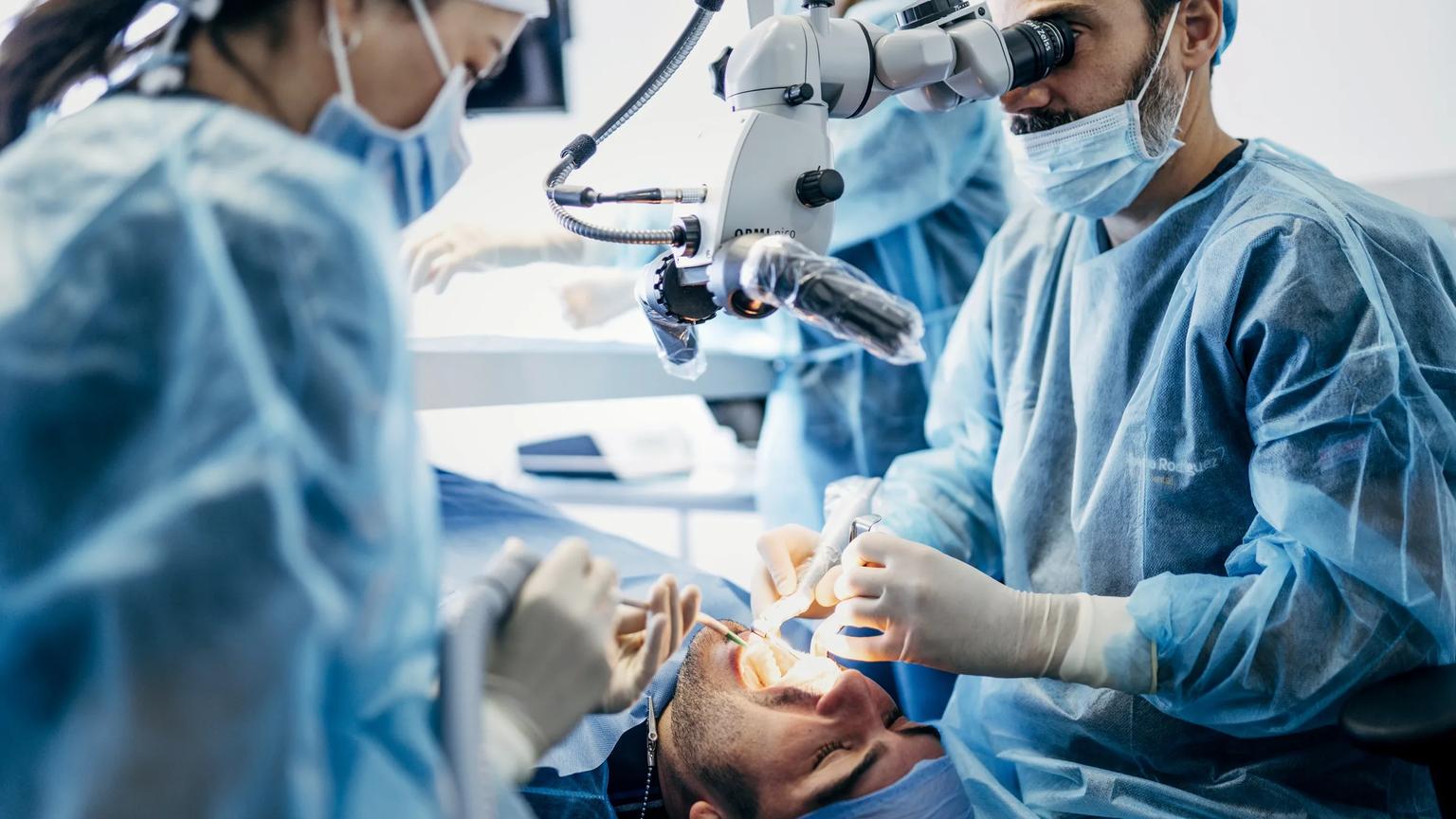
- microTESE — microdissection testicular sperm extraction. An open procedure in which the testis is delivered and opened widely under an operating microscope, allowing the surgeon to inspect the seminiferous tubules and selectively excise the larger, opaque tubules that the urological literature associates with active spermatogenesis, while removing less tissue overall than blind multiple biopsies. Guidance from ASRM and the American Urological Association discusses microTESE specifically in the context of non-obstructive azoospermia, and it requires microsurgical training, theatre time and — critically — an embryology team prepared for a prolonged, systematic search.
From Theatre to Laboratory: Male Factor at the ICSI Bench
Two teaching points deserve emphasis. First, technique selection follows the work-up: percutaneous, epididymal-level approaches presuppose obstruction with preserved production, whereas NOA points to open testicular approaches. Second, no retrieval procedure should be scheduled as an isolated surgical event; each is one half of a coordinated exercise whose other half takes place at the laboratory bench.
Retrieved material reaches the embryology laboratory as epididymal fluid or testicular tissue, and its handling illustrates why male-factor training must include the laboratory perspective. Tissue from TESE or microTESE is mechanically minced — with enzymatic digestion described in the literature as an adjunct in selected cases — and the resulting suspension is searched under the microscope for spermatozoa, a process that in non-obstructive cases can be genuinely laborious and can run in parallel with the surgery itself, with the laboratory feeding findings back to the operating surgeon. Standard laboratory disciplines apply throughout: witnessing, labelling and traceability at every transfer of material, as described in our companion walkthrough of the IVF laboratory workflow for trainees.
Fertilisation with surgically retrieved sperm is performed by ICSI. The reasoning is practical rather than doctrinal: conventional insemination depends on sperm numbers, motility and progression that epididymal and testicular samples rarely provide, whereas ICSI requires the embryologist to select and inject a single spermatozoon into each mature oocyte. Trainees learn to identify viable, often barely motile or immotile, spermatozoa in a testicular suspension — using the laboratory manoeuvres the andrology literature describes for assessing viability in immotile sperm — a skill set some distance beyond routine ejaculate preparation.
Coordination is the final workflow theme. A unit must decide, within its own protocols, whether retrieval is synchronised with the female partner's oocyte retrieval or performed in advance with cryopreservation of the retrieved sperm or tissue; the peer-reviewed literature discusses both patterns, and the choice engages scheduling, theatre availability, laboratory capacity and counselling about the possibility that no sperm are found on the day. Cryopreservation of surplus retrieved material, where quality permits, is likewise a standard consideration, since it may spare the patient a repeat surgical procedure. None of these decisions belongs to the surgeon or the embryologist alone; they are made across the clinical–laboratory interface, which is precisely why male factor rewards joint training of physicians and embryologists.
Continuing Your Training in Reproductive Medicine
Male-factor infertility rewards exactly the kind of education that crosses the clinical–laboratory boundary: the clinician who orders and interprets the work-up benefits from understanding what a testicular suspension demands of the ICSI bench, and the embryologist searching that suspension benefits from understanding the surgical reasoning that produced it. Reading the guideline frameworks from ASRM, ESHRE and the urological societies alongside time spent in a working unit is the practical way to build that shared picture.
Clinicians who want to consolidate these connections in a supervised setting can review the fine-ART Masterclass, a two-day hands-on training programme delivered with Centrum Clinic in Ankara, in which physicians and embryologists work on real cases under supervision on the clinical side and follow the embryology laboratory through structured observation.